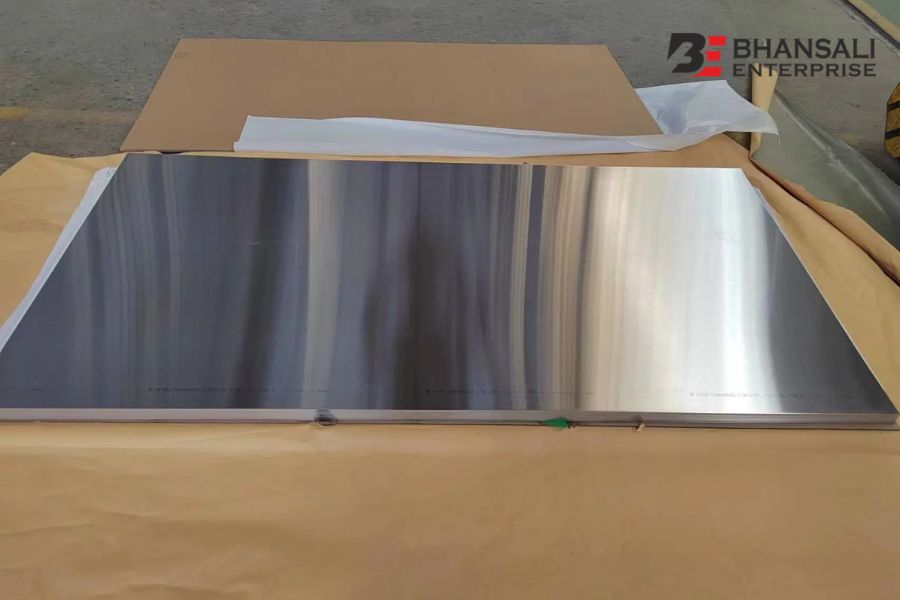
Seawater destroys equipment fast. Salt spray, constant humidity, and cyclic wetting attack metal surfaces within months, and pitting corrosion can damage standard steel components long before their rated service life ends. Ships, offshore platforms, and coastal plants all face this same enemy every day. Monel 400 sheets solve this problem through a nickel-copper composition that resists seawater attack far better than conventional alloys, combining strength with a service life that stretches into decades rather than years. Many shipbuilders and offshore fabricators now specify marine grade Monel 400 sheets for hulls, piping, and heat exchange components that stay submerged or spray-exposed around the clock. This blog covers the properties, benefits, applications, and selection factors that matter when sourcing Monel alloy 400 sheets.
What Are Monel 400 Sheets?
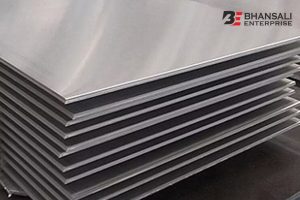
Monel 400 sheets are flat-rolled products made from a nickel-copper alloy containing roughly 63-70% nickel and 28-34% copper, with small additions of iron, manganese, and carbon. This ratio pairs the corrosion resistance of nickel with the strength and workability of copper. Tensile strength runs between 70,000 and 85,000 PSI in the annealed condition, with hardness in the 65-75 Rockwell B range. The alloy is registered under UNS N04400 and covered by ASTM B127 and ASME SB127 specifications. Stainless steel relies on a chromium oxide layer for protection, and that layer breaks down in chloride-rich seawater. Monel 400 does not depend on this passive film, so it keeps performing where 304 and 316 stainless steel start pitting within a single season.
Key Properties of Monel 400 Sheets
- Outstanding seawater corrosion resistance
Resists attack from flowing and stagnant seawater alike, unlike stainless grades that suffer under chloride exposure.
- High mechanical strength
Yield strength reaches 28,000 to 40,000 PSI in the annealed state, holding up under wave loading.
- Excellent resistance to pitting and crevice corrosion
Monel 400 sheets avoid the localized corrosion that destroys stainless steel in gasketed joints.
- Good weldability and fabrication
Welds using GTAW, GMAW, or SMAW without special pre-heat, and forms readily into curved hull sections.
- High thermal stability
Mechanical properties stay consistent from sub-zero conditions up to 480°C.
- Excellent durability in marine environments
Continuous salt spray and immersion do not degrade the surface the way they do with carbon steel.
- Long operational lifespan
Properly fabricated Monel Alloy 400 sheet components routinely exceed 25 years in seawater systems.
Benefits of Using Monel 400 Sheets in Marine Engineering
- Exceptional resistance to seawater and saltwater corrosion
UNS N04400 sheets hold surface integrity across splash zones, tidal zones, and full immersion.
- Long service life in harsh marine environments
Fewer replacement cycles mean lower lifetime procurement costs.
- Reduced maintenance and replacement costs
Operators inspect and repaint less often than with carbon steel or lower-grade stainless.
- High strength under demanding operating conditions
Nickel copper alloy 400 sheets handle wave, vibration, and pressure loading without premature fatigue.
- Reliable performance in offshore applications
Dimensional stability holds under combined pressure cycling and saline exposure.
- Excellent resistance to biofouling
Marine growth attaches less aggressively to Monel surfaces than to bare steel.
- Cost-effective over the product lifecycle
Higher upfront cost gets offset by decades of reduced downtime and fewer emergency repairs.
Applications of Monel 400 Sheets in Marine Engineering
- Monel 400 sheets are used in ship hull components where localised corrosion would otherwise affect the structural integrity especially near waterlines and thruster tunnels.
- The alloy is used in seawater piping systems for passage of raw water through cooling and ballast circuits without scaling.
- Heat exchangers and condensers use Monel sheet in tube plates and baffles because it resists both the seawater side and process side of thermal exchange.
- Offshore platforms specify the alloy for splash-zone cladding exposed to constant salt spray.
- Marine pumps and valves use Monel 400 for wear rings and trim where erosion-corrosion would shorten component life.
- Desalination plants depend on it for evaporator components and brine piping at elevated temperatures.
- Monel is used for marine fasteners and propeller shafts. It is strong and compatible with bronze propellers in terms of galvanic corrosion.
- Coastal infrastructure and dock equipment, including mooring hardware, use Monel sheet where atmospheric salt exposure runs continuously.
Factors to Consider When Choosing Monel 400 Sheets
Selecting the right sheet starts with the marine operating environment, since fully submerged components face different corrosion mechanisms than splash-zone applications. Sheet thickness and dimensions are just as important, because underspecifying gauge results in premature deformation under wave and vibration stress. Fabrication and welding requirements should be reviewed early on as some assemblies need post weld stress relief or specific filler metal matching. ASTM and ASME standards compliance, B127 and SB127 respectively, guarantees the material is within tolerances for classed marine work. Different applications have different mechanical strength requirements, and thus different tensile specifications for hull plating and fastener stock. Material certifications and quality testing, including mill test certificates, verify the sheet meets its stated grade before it reaches the fabrication shop.
Common Mistakes to Avoid
Choosing the wrong grade of alloy is responsible for more marine corrosion failures than any one design flaw. Monel 400 is different from Monel K-500 or any other nickel alloy in strength and suitability. Failure to incorporate seawater corrosion requirements in the design stage often results in costly retrofits after components start to pit within a few years. Specifying a sheet that is either too thin or unnecessarily heavy will increase the material cost and make fabrication difficult. Failure to consider fabrication compatibility issues, particularly weld procedure qualification, can result in joint failures that compromise corrosion resistance. Without verified certifications, buyers risk buying off-spec material that will not perform once installed.
Conclusion
Monel 400 sheets bring together seawater corrosion resistance, mechanical strength, and long-term durability in a way few alloys match for marine service. From ship hulls and seawater piping to offshore platforms, desalination plants, and coastal infrastructure, the alloy handles the combination of salt, moisture, and mechanical stress that defines marine engineering. Selecting the right grade, thickness and certification for each application ensures that the equipment is reliable and reduces maintenance over the working life. Bhansali Enterprise is a manufacturer of Monel Alloy 400 sheets in India that are tested to ASTM B127 & ASME SB127 standards for shipbuilding, offshore and marine infrastructure projects for reliable and long lasting performance in seawater environments.